
Tea Etiquette in Zero G
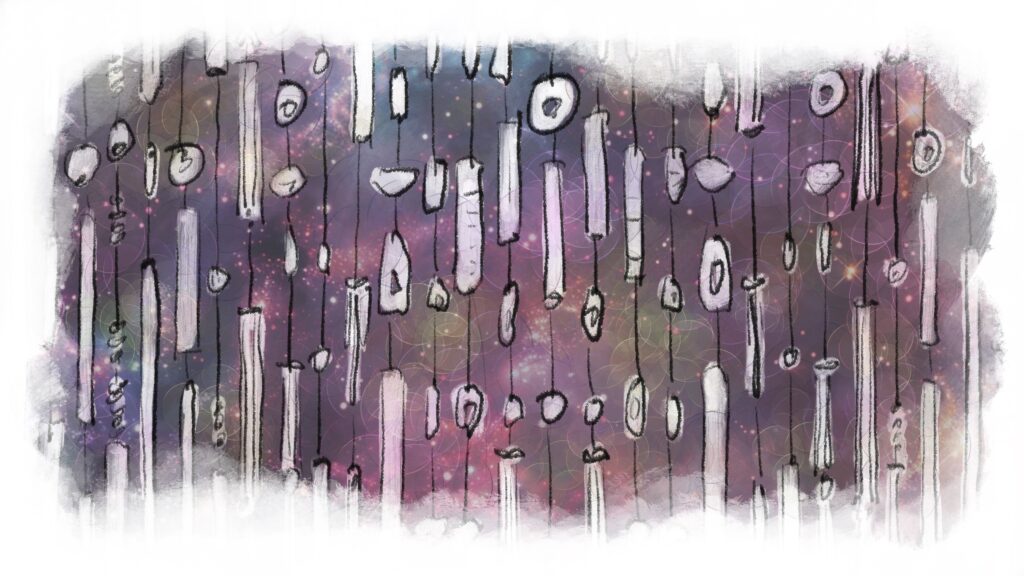
There’s no wind in space. Except for solar wind, of course. That goes without saying. But there’s no actual wind wind, no breeze, no weather, no atmosphere, nothing like that. And what this means is that there are no wind chimes in space. Or at least, that’s the perceived wisdom, and it’s just as well as I hate wind chimes. I hate the noise they make and I hate the way that people put out these wind chimes like they’re so goddamn special, like they want to find just a little bit of magic in the world, well let me tell you buster there’s nothing magic about wind chimes. I thought space would be one of the places where I’d be safe from wind chimes. How wrong I would turn out to be.
When Wayne arrived in the capsule, Australian Wayne with his doctorate in astrophysics, when the capsule docked and the airlock opened and Wayne came through all smiles and high fives, the first thing he said was, “Fellas, I’ve brought some wind chimes with me, I hope you don’t mind,” and everyone slapped him on the back and there were more high fives and that’s when I pointed out to him that there was no wind in space.
“Solar wind,” he pointed out.
Smug bastard.
The station commander, as a goodwill welcome gesture, hung the wind chimes in the access tunnel between science pod B and the main accommodation capsule, and what with the lack of gravity, they just kind of hang there pointing in four different directions like the hand of an arthritic robot, and every time someone passes through the access tunnel, those tinkly bastard wind chimes ring out around the space station, and I just want to throw them out of the airlock, and then jump up and down on whatever experiment Wayne has been assigned.
“Reminds me of home,” Wayne told us, after Commander Stacey had hung them in place.
“Do you live somewhere particularly windy?” Stacey had asked.
“Not particularly,” Wayne had replied. “In fact, the climate is very settled out there in the outback. Hardly a breath of wind at all. Which makes it all the more auspicious when the wind chimes chime. You’ll have to forgive me if I get a bit emotional every now and then.”
I looked out the window at planet Earth. We were just passing over the Pacific Ocean. It seemed that we were always just passing over the Pacific Ocean, but then the Pacific Ocean does take up quite a bit of space on the planet. And I was floating near the drawers in which we kept the experiments sent in by school children. We were supposed to monitor these experiments, more as a goodwill gesture than anything else, as the experiments had hardly any actual scientific worth, but it was more of a case of out of sight, out of mind. I hadn’t opened the drawers in a long time, and the experiments that I had done had bored me senseless.
“Say,” Wayne said. “Do you guys get homesick?”
Grow up, I thought. But I got homesick all the time. I didn’t want to tell him this. Or any of the others. I missed my wife and my kids as much as the next person. I certainly didn’t miss the wind chimes. It was all a natural part of the situation we had found ourselves in and we would all have to find ways of dealing with it.
Discordant tuneless tinkles.
“You see, that’s the one thing that they can’t really prepare you for,” Wayne continued.
Perhaps, I thought, I really should open the drawers containing the experiments sent to us by the schools. It would take my mind off so many things, wouldn’t it?
…
When I told Debs that I would be spending almost a year on the space station, she did not react with the sadness that I’d been anticipating. Indeed, she had seemed somewhat gleeful, and that afternoon I’d caught her dancing in the backyard of our suburban Texan home. It was the most beautiful and hypnotic dance I’d ever seen. Her hands performed circular movements around each other and around her lithe body in much the same manner as the various moons around the planet Jupiter.
“Aren’t you concerned about missing our five-year anniversary?” I’d asked.
“Oh, I didn’t realize it was coming up.”
That night we’d sat in the hot tub. I lay my head back and I looked up at the stars. I concentrated on the satellites, those moving dots of light whose mysterious mechanized orbits are known only by computers, and I said something like, “Oh, Debs, pretty soon I’ll just be one of those dots of moving light, steady and sure and man-made and reflecting the sun’s light back to this lowly suburban backyard, and every time I pass, I swear it, every single time I pass over, I’ll say a little prayer, and offer a little wish,” and she’d replied, “I might redecorate the lounge.”
A few weeks later as we prepared to blast off from the launch pad, ground control had patched through messages from our loved ones to the three-man crew. Children, wives, lovers, partners. It was a serene and touching episode. Deb’s voice had been accompanied by shopping mall Muzak and she told me that she was looking at carpet samples. Her last words to me were, “You can’t go wrong with beige.”
And now here I was, orbiting the planet several times a day, eating dinner from a toothpaste tube and trying not to throw some wind chimes out into the inky depths of space.
…
Wayne apparently was an expert in tortoises. Quite why an astrophysicist should be an expert in tortoises is anyone’s guess. But he would get very excited every time we passed over the Galápagos Islands.
“Galápagos!” he’d say, “I salute you, sir!”
It was not like the Galápagos could respond, either.
“Did you spend time there?” I asked.
“No, but I have an affinity with the place. And do you know why?” he asked.
“Go on.”
He leant towards me.
“The tortoises,” he said.
Due to the vagaries and trajectory of the space station’s orbit, it wasn’t always guaranteed to fly over the Galápagos Islands, but every time that it did, Wayne would blurt out, “Galápagos! I salute you, sir!”
I knew all about Darwin and the tortoises. Wayne didn’t have to offer any explanation, and as, ostensibly, we were all scientists on this mission, he shouldn’t have felt it necessary.
“I remember one long hot summer,” he said, leaning back as best he could. “The heat was intense. Do you know what that’s like? Not a breath of wind, either. I was down by the well with Greg — that’s my brother, I’ll have to show you some photographs — and we were just discussing the likelihood of a drought and what this would mean to the livestock. Did I mention we kept livestock? And I remember looking up at the sky, this perfect blue sky, with the sun sitting there high in the middle of it, and I saw the sun right then and there as what it actually was, an interplanetary body whose gravity and radiation led to life on this very planet. And it was at that moment that I decided, that exact moment, that I would train to join the space agency, that I might do my part to make sure that these droughts never happen again, and I tell you what happened, I’ll tell you, right? That’s when the wind chimes chimed. That exact moment. The first subtle breeze in weeks. The wind chimes chimed and it was as if I could taste the future on my tongue. I saw it as an omen. Greg saw it too. Greg heard it. Like an idea made magical, a soundtrack to the future itself. Those steel tubes jingling together, ever so slightly. My life has never been the same since.”
He then looked out of the porthole window.
“Galápagos! I salute you, sir!”
“That’s the Isle of Wight.”
…
Commander Stacey floated in a nonchalant manner and told us this anecdote about when she was a kid, and it was a hot night, and she just couldn’t sleep because it was so stuffy and uncomfortable, when she came up with the idea of pretending that her neighbors had been kidnapped. She would phone the police and imitate them begging for help, pleading with the police to come to their address immediately, knowing that the police were bound to send one of their helicopters and that she could open her windows and cool herself in the downdraught from its rotors. We all laughed, of course, and then Wayne regaled us with the story of a friend of his who worked at the local zoo, and each night he had to shoo away one of the neighbor’s cats. There were two reasons for this, he had explained, the first being that the cat would saunter around the zoo and upset all of the other animals there, the second reason being that it had somehow found its way into the red panda’s enclosure and go to sleep, and when they opened the zoo every morning, the public just thought that it was a really naff zoo exhibit and that the zoo had run out of ideas.
I could not think of a similar anecdote with which to entertain them. I have lived a life conditioned to the ignorance of the superfluous. Though I repeated my story that I was only on the mission at all as a replacement to Captain Jake McGuire. Oh, Captain Jake McGuire, heroic test pilot and grinning poster boy of rocket science, who had been thrown off the mission after he’d developed a particularly nasty case of dandruff. Dandruff, you see, floats off the scalp in every direction at once in zero G and gets into the controls and the vents and the fans and the wiring looms of the space station, thereby potentially causing short circuits, fires, malfunctioning equipment. At once brave Captain Jack McGuire was nicknamed Flaky Jake and his astronaut career was done. This is why so many of the top astronauts are slapheads.
“Do you miss your wife?” Wayne asked, “And kids?”
Of course I did, but I didn’t want him to know this. Fragile masculinity is masculinity all the same, and they’d all be waiting for me when I got home. Instead, Wayne started talking about a friend of his whose bizarre fetish in the bedroom was to shrug on a beekeeper’s outfit, and it was at this moment that ground control reminded us that what we were saying was being live-streamed to 158 schools across the world.
…
Boredom insisted itself upon me to such an extent that I decided to open the drawers of experiments that the schools had sent to us. We were not obliged to complete any of them, but it did wonders, apparently, for public relations if we at least were to make the effort. Within twenty minutes I had answered quite a few burning questions sent in by various education establishments.
Yes, stinging nettles still stung in space.
No, the blueberry muffin had not retained any of its freshness in zero G.
No, it was not possible to play tiddlywinks in space.
Sadly, the mouse had died.
No, Felicity Beckett from Portland, Oregon, I cannot hear you playing your flute from space. Not even if I concentrate.
Using a tissue and a comb to play a tune still worked in space.
The moisture content and nutrients of the sample of tumble dryer fluff had not lost any of their chemical composition.
And so on.
I decided to do one last experiment of the day, and that was an intriguing box delivered by a school somewhere in West Sussex, who wondered whether it was still possible to adhere to the unwritten rules of tea etiquette in an environment where there was no conceivable measure of up or down. Indeed, the experiment was set out as more a sociological examination than a physical or scientific endeavor, and as such, three teacups, a teapot, a milk jug, a sugar bowl and a tray had all been provided.
My first impulse was to reply with a very formal and prescriptive response pointing out that the physical impediments to a formal tea party on the space station precluded a strict adherence to the unwritten rules of tea etiquette, but then the professional side of my training took over and I decided that I would at least give it a go.
“Forgive my ignorance,” Wayne said, “But what are the unwritten rules of tea etiquette?”
He had floated over in a quizzical manner, having been calibrating some piece of important space hardware when he had seen me open the box which contained the teapot.
“I’m not sure.”
I read from the piece of paper which the school in West Sussex had included in the experiment box.
“The napkin must be folded and placed to the left of the saucer. Only the host of the tea party should pour the tea. When the tea pot is left on the table, it is polite that the spout faces the host. One must leave the saucer on the table surface and raise the cup independently of the saucer. One must only look into the cup when sipping. Tea must be stroked by the spoon, and not stirred, nor should the spoon touch the sides of the cup. One must not extend one’s little finger.”
We both floated there for a while, looking at the tea paraphernalia.
“Sounds like too much effort,” Wayne said. “The whole procedure is somewhat tortoise-like.”
“In that case, then I should think it would be just your kind of thing.”
The teapot was pleasantly constructed in china with a blue and green floral pattern around its midsection. The three cups were of a fine bone china and also carried the same floral pattern, with jaunty handles which had been architecturally constructed with a small flourish where the lower part of the handle joined the side of the cup. The sugar bowl and milk jug were similarly patterned.
“I might put all of this back in its box,” I said.
“Sensible advice, and… Galápagos! I salute you, Sir!… And I wouldn’t blame you for taking such a step.”
And yet… And yet the two of us just floated there, looking at the tea making equipment.
“Stacey!” Wayne yelled, “Pop the kettle on!”
Stacey was in the second science module.
“We haven’t got a kettle!” she yelled.
…
Society is nothing without rules, and the same goes for sport, commerce, science, and any kind of endeavor in which the result benefits either individuals, customers, stakeholders, or the common good. Reminded of this by the proposed tea etiquette experiment, I spent the evening pondering on Debs and the kids, wondering if at any moment during our relationship I had transgressed, or gone against the assumed rules of our engagement. Certainly, there have been times during which I’d been keen to share whatever triumph I’d accomplished during my years as a test pilot in the Air Force, but maybe even to do this was a transgression of sorts, a sudden and uncalled for concentration on the self.
Maybe I’d have come home, and explained in breathless detail just how much skill I’d employed in taking an experimental jet to the fringes of the atmosphere to perform maneuvers which had taken the craft almost to the point of destruction, maybe this is what I’d come home and explained, when it wasn’t really my part to go into such detail, about how the mechanics and the technicians back at the airfield had praised my airmanship and techniques, maybe I’d come home and explained all of this and she had had a pretty rough day, or replied with something mundane like, “Yes, but you left the refrigerator door open all night.” Or that time that she told me she was pregnant and the first thing I did was complain that now I’d have to go to the lawyer and change my will. She’d hurled her shoe at me.
“You seem somewhat dejected,” Commander Stacey pointed out, later on that evening.
The first of the unwritten rules of tea etiquette was that the napkin should be folded and placed to the left of the saucer. The napkin, I realized, stood for one’s hopes and dreams and achievements, while the saucer was the safety receptacle that was the space station itself. Or my marriage, one or the other. One must therefore ignore one’s private hopes and dreams and achievements, fold them, place them on the saucer of the cup of life.
“I’m fine,” I replied.
“Are you sure? As commander, I have certain responsibilities when it comes to the well-being of my staff…”
“Such things should not be discussed,” I tell them. “There are certain tenets of expected behavior which benefit or maintain the proper sobriety necessary for the execution of our tasks.”
“If you say so.”
For is this mission of ours on the space station nothing but a meaningless ceremony, a set of traits and expectations which are undertaken with no clear written rules, but the assumed strictures of what has come before?
“But if there is anything which is bothering you, then you will come and talk to me, won’t you?”
“Things are fine,” I told them.
“You know, it’s only natural that one should think about one’s loved ones, for example, or the pressures of the job…”
“Things are fine,” I repeated.
The napkin was securely folded next to the cup and I would pretend that I would never need it.
Commander Stacey floated away with a backward glance.
…
Because Commander Stacey was the host of this expedition. I understood that, and I understood that because of this, there were certain duties which only they had cause to worry about. They were being paid much more than I was, for a start. They had the rank and the training and the responsibility. The same way that the host of a tea party has a certain responsibility to dispense tea. The second unwritten rule of tea etiquette was a two-part clause which I reread just to make sure that I understood it. Only the host of the tea party should pour the tea. When the tea pot is left on the table, it is polite that the spout faces the host. Only they should bear the brunt of whatever unpleasantness might impinge itself upon our ceremony, whether that be the implied psychological torment of one of their guests, or merely a view of the teapot spout.
In the middle of the accommodation capsule there was a large vent, connected to various pieces of equipment by a long tube, the same consistency and concertina design as that which one might attach to the rear of a tumble dryer. In the early hours of the morning, while my other astronauts were slumbering in their sleep bags which were anchored to their usual places on the walls of the space station, I set to work moving this vent so that it faced Commander Stacey’s position. In such a way, should they wake at any moment and stare straight ahead, they might see the vent facing them and be the only person in that room inconvenienced by its existence, should they ever have cause to worry about such things.
The vent pumped in cool air, manufactured by one of the many life support machines. If they concentrated hard enough, they might feel a slight breeze, presumably cooling and refreshing, the same way that the host of the tea party might, (depending on the dimensions of the table), be subject to the steam rising ever so subtly from the spout of the teapot.
“What are you doing?” Wayne asked.
I looked up and saw that he was awake, watching me intently as I worked.
“I couldn’t sleep,” I told him. “So I thought I’d do some light maintenance.”
“Did Commander Stacey ask you to do that?”
“It needed doing,” I replied.
But Wayne was half asleep and as he drifted back off into slumber, he mouthed the word, tortoise, and then he was gone.
I floated down to the observation dome and I sat there for a while looking at the planet’s surface as it passed beneath us. We were flying over the Pacific, as normal. The sun was reflected back from the blue surface of the ocean, the same sun which would soon wrap its way around the earth and wake my wife and kids, and welcome them with a new day. I wondered, not for the first time, how the decorating was getting on in the living room.
Because my family, did they not support me at all times? Were they not always there, catching me when I dripped splashes of hot, sweetened fragility, could I not rest upon them the same way that a cup rests on a saucer? We fitted exactly, my saucer family and me. We were made by the same manufacturer of china ceramics, poetry, porcelain, the same dainty pattern of interlocking hearts, the saucer designed specifically to accommodate the cup, the cup designed specifically to fit into the saucer. Yet they were down there on the planet, the same way that the saucer stays on the table during a tea party. And in such a way I was, I now gleefully realized, adhering to the third unwritten rule of tea etiquette. One must leave the saucer on the table surface and raise the cup independently of the saucer. And that was the key word, independently.
…
One must look only into the cup when sipping, because sipping is the acknowledgement of those structures of life to which we must all apply ourselves. In other words, concentrate on the interior, and become, if not already, deeply introspective.
The next morning, I was tasked with the allocation of our breakfast rations, plastic tubes containing a scientifically-concocted approximation of food. The Full English is a particularly disgusting mush. But one must only look into the cup when sipping, so once I’d opened the refrigerated box in which our supplies were kept, I fished out only the one tube, and had it all to myself.
“Nothing for us, then?” Wayne asked.
The other assumption that one must take from the rule is that it is rude to remove one’s focus from the task at hand. So it wasn’t until I’d finished the tube of breakfast mush and sat for a while in a quiet, contemplative silence, that I replied to his comment.
“Nope.”
During my months of training at the space center, we had been taught to be as considered and academic in our responses and general outlook as one might expect from any professional. Language had to be concise, informative, precise. We were taught not to rush in to snap judgments or opinions, to keep the emotion to a minimum, and to treat the spoken word as a conduit for facts.
This is what made Wayne’s resulting explosion of pent-up rage all the more surprising. He went ape shit. He flew across the accommodation capsule with his arms outstretched, like a really naff Superman, and the next thing I knew was that he had his fingers wrapped around my throat. It was only when Commander Stacey whacked him over the head with a sink plunger, that he finally relented.
And all he could say, as he rubbed his head, was, “Why the hell have we got a sink plunger?” (Apparently the suction it creates mimics the vacuum of space).
…
Her face was barely visible on the laptop screen. But even so, I was trying to peer around her, to see what color she had chosen for the walls of the lounge.
“How are the kids?” I asked.
“Kids are kids.”
“Do they miss their Daddy?”
“They haven’t mentioned it.”
She smiled, and she moved a strand of hair behind her ear.
“The decorating is almost finished.”
“Can I have a look? Move the camera, so that I can have a look.”
“It will be a nice surprise for when you get back.”
“But I want to see it now.”
She let out a sigh and moved her laptop. The picture went a bit fuzzy and when it cleared, I could see our lounge. The walls were magnolia. It was nighttime.
“It looks the same.”
“Yes, I just repainted them the same color as they were before.”
“You didn’t change anything?”
“There’s nothing wrong with magnolia.”
“I thought you were set on using beige?”
“Yes, but then when I got to the hardware shop, I looked at the magnolia and I thought, well, if you’re aiming for beige, then you might as well go the full distance and have magnolia.”
“You can’t go wrong with beige. That’s what you said.”
“Well, it turns out that you can.”
“Tonight is our five-year anniversary,” I said.
“That was last night. Listen…” She lowered her voice. “Are you near anyone?”
I looked around. Neither of the other crew were nearby.
“You’re safe.”
“I had a phone call from Ground Control. From a psychologist. They said it was just a routine call, but…”
“But what?”
“They were asking all kinds of questions.”
“Like what?”
“They were asking if you were all right.”
I laughed.
“Never been better.”
“Are you sure?”
“I’ve been drinking a lot of very calming tea.”
“Magnolia tea?” she asked.
“I didn’t realize there was such a thing.”
“Anyway… It feels like they’re worried about you. And that makes me worry about you, too.”
Neither of us said anything for a long time.
“I quite like tea. Have I ever told you that before? You know, a nice cup of tea can be very refreshing.”
“You’re actually drinking tea up there?”
“No. But I’m… pretending to.”
“Right.”
“Also, I know it sounds silly, but when I get home, I want to get some wind chimes.”
“I thought you hated wind chimes?”
“And then we can sit in the backyard on those hot, humid nights, drinking tea and listening to the wind chimes.”
Debs laughed.
“OK, “she said. “I’ll go out tomorrow and I’ll get us some wind chimes. If that’s what will make you happy. Wind chimes and a teapot.”
It was at this moment that the signal cut out. I stared at the blank screen for a while. I had been sure that tonight was our five-year anniversary. But it’s difficult to figure out the time zones.
…
Tea must be stroked by the spoon, and not stirred, nor should the spoon touch the sides of the cup.
Which is an easy one, because as inhabitants of the space station, we’d learned how to fly from capsule to capsule without touching the fragile sides of the vehicle.
But it meant more than that, didn’t it? It meant that we had to go through life without causing any upset or undue agitation, either clockwise or anticlockwise.
I’d once worked with a German lady called Ida, and of all the words she taught me in German, the one that I remembered most was Kreisbewegung, which meant circular motion. And you wouldn’t believe how many times during a day I’d find myself using the German word Kreisbewegung. I’d be cleaning the window of my car, for example, on the inside, with a duster, my hand going around and around, and I’d say to myself, Kreisbewegung. Or I’d be in the lounge, polishing the coffee table, and I’d look at my hand and I’d say to myself, Kreisbewegung. Or at the space center, I’d be on the centrifugal force machine going around and around and around and around, feeling the G‑force and barely able to turn my head, and I’d shout out at the top of my lungs, “Kreisbewegung!” and they’d stop the machine and open the capsule and they’d say, “What was that?” and I’d reply, “Circular motion.”
In fact, it was probably at that moment that they decided to go with Flaky Jake for this mission, until his ill-fated date with the dermatologist.
“I’m so sorry I upset you the other day,” I said to Wayne, stroking his arm.
He looked at me and he smiled.
“I see in you,” he said, “the fortitude and the compassion of the humble tortoise.”
“Well,” I replied, “you’ve got to stick your neck out.”
Which I knew didn’t make any sense.
“Please stop stroking my arm,” he said.
“It’s more of a massage.”
“That’s not a massage. A massage is conducted, usually, in a circular motion.”
“Kreisbewegung,” I said.
“Galápagos! I salute you, sir!” he replied.
Commander Stacey was measuring the neutrinos they’d captured overnight in a very scientific neutrino trap.
“How many?” I asked.
“Six,” they replied.
The neutrinos looked like the tea leaves left at the bottom of a cup.
“Did you use a strainer?” I asked.
“Excuse me?”
“Check the strainer.”
“I’m worried about you,” they said.
I began to stroke Commander Stacey’s arm.
“Is this inappropriate behavior?”
“Actually,” they said, “that’s quite nice.”
And neither of us said anything for a while, and the space station just kind of hummed and clicked like it always did. That afternoon the re-entry craft would be arriving bringing with it a fresh crew and it would be taking me back home. For some reason, Ground Control had decided to shorten the length of my mission by a few weeks, and I knew that once it docked with us, things would never be the same again.
I left Commander Stacey and I went to the store capsule, shrugged myself into my space suit. I would need it for the return journey, but there was nothing better than being prepared, even though I had a few hours. When I came back, my head knocked against the wind chimes, and I made a beeline for the drawer full of experiments that I’d been working on.
I wrote some notes.
Yes, it is possible to follow the assumed rules of tea etiquette in zero G.
Which was not strictly true, because I hadn’t finished the experiment yet. There was one left, one vital rule which I had not yet fully explored. One must not extend one’s little finger. Now this, I understood, was not as slyly sexual as one might imagine, rather a more coded reference to physically inserting yourself in situations which might otherwise cause offence, worry or harm.
“Where are you going with that?” Wayne asked, as I lifted the box containing the tea-making paraphernalia out of the experiments drawer.
“Out,” I replied.
“Good day for it,” he observed.
I placed the teapot, the cup, the saucer, the milk jug, the sugar bowl, the strainer and the spoon on the tray, filled the pot with hot water from the protein mush preparation urn, and then in a very graceful manner, I flew across the accommodation capsule to the airlock. Amazingly, the various pieces which made up the tea set remained in their positions and were not overtly affected by zero gravity. I placed the tray on my lap and pulled the heavy door closed, locked it, and then opened the other, until there was just myself and the vast expanse of space.
It didn’t take much of an effort to push myself away from the airlock and out into space. I probably had enough oxygen for half an hour or so, but then, how long does it take to have a cuppa? Five minutes at the most. I turned around and looked at the space station, noting how it looked, in the rising sun, like the innards and digestive system of a robot, then turned and faced the earth itself in all its blue and green sublimity. The tray still on my lap, I let out a sigh, and then busied myself pouring the stewed brown liquid from the spout into a cup. Naturally, most of it flew off into space, so I had to put my hand over the cup in a manner which surely would have offended even the most liberal tea etiquette expert. Once satisfied that the tea would stay in the ceramic cup, I put down the teapot, left the saucer on the tray, lifted the cup and…
Clink, against the glass face of my space helmet.
“Bugger,” I whispered.
The life support hose led back to the airlock where Commander Stacey and Wayne were now pulling me back. And to my left, I could see the re-entry craft approaching.
I tried to sip the tea again.
Clink.
One particularly hard yank, and the tray tumbled from my lap, the tea pot, the saucer, the strainer, the milk jug, the sugar bowl, all of them drifted off into orbit around planet earth with all the other pieces of space junk.
Backwards, I was being pulled. Backwards, backwards, back to the airlock and the space station.
—
Care to Share?
Consider posting a note of comment on this item:
—§—
Previous Post
—